IG Farben
The Zone of InterestIG Farben is the industrial power whose partnership with the camp system at Buna-Werke makes the novel’s central contradiction brutally concrete: a corporation seeks wartime production through a concentration camp, while the people whose labor and lives are consumed remain, in the company’s calculations, costs and supplies. Its presence extends from financing camp operations and observing forced labor to Bayer’s fatal experiments on women prisoners. The Buna-Werke ultimately produces neither synthetic rubber nor synthetic fuel, but the failure of the industrial project does not erase the exploitation or the postwar convictions of its managers.
Corporate Power and the Buna-Werke
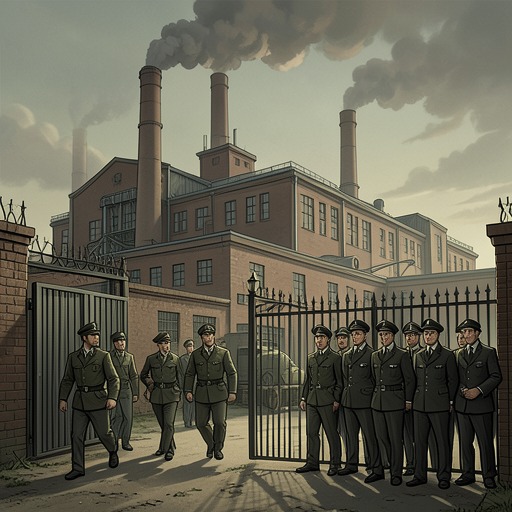
The company enters the camp’s administration through a financial arrangement presented to Paul Doll by Frithuric Burckl and Suitbert Seedig. Burckl reports that the company’s executive board has agreed to pay. Seedig specifies the division of responsibility: Doll is to provide inmates and guards, while overall security remains in his hands; IG Farben will cover the costs of construction and operation. Burckl adds that the company will provide food independently, avoiding exchanges with the main camp and, he hopes, typhus. The proposed arrangement does not set industry apart from camp authority. It distributes the work of maintaining the industrial camp across corporate funding and SS control, with prisoners supplied as labor.
Doll recognizes the arrangement’s institutional novelty, describing a world-renowned concern with its own concentration camp. His response registers not moral alarm but the oddity of the corporate undertaking. That reaction is part of the structure the novel exposes: the camp can be discussed in the language of administration, security, expenses, food, and production even as its basic resource is captive people.
Buna’s importance is repeatedly measured against the demands of war. At the plant, Angelus Thomsen is asked whether work is progressing and whether the company is winning, because the war needs Buna. Thomsen answers that rubber, like ball bearings, is indispensable to making war. Yet he also says progress is steady only if the established methods continue. The exchange sets industrial necessity beside the operation’s dependence on practices and conditions that are neither stable nor humane. Elsewhere, Suitbert Seedig describes prisoners marching for ninety minutes to Buna after reveille at three, working until six, returning at eight, and carrying casualties. His question about how exhausted prisoners can produce useful work makes the human cost visible even within the language of efficiency.
Forced Labor and the Industrial Gaze
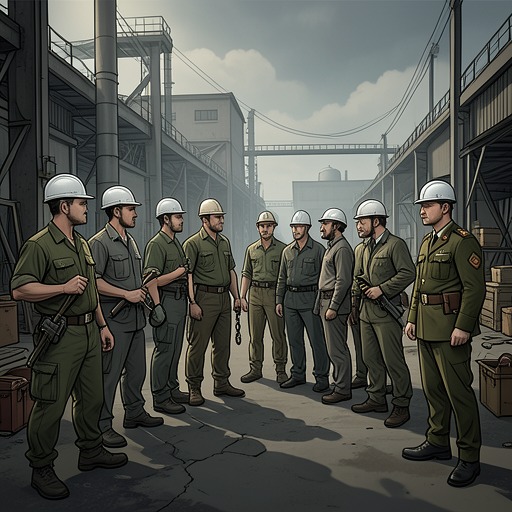
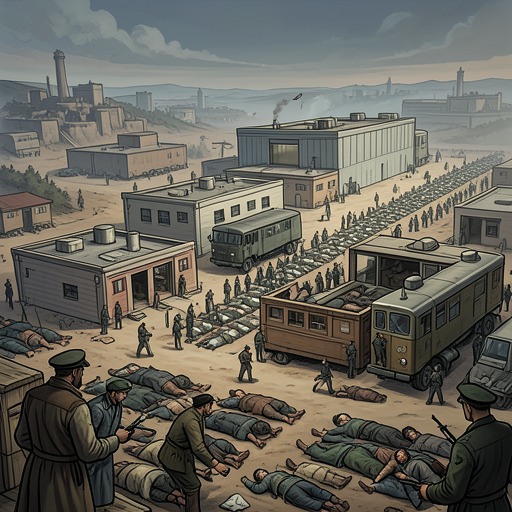
The view from the Buna-Werke office gives the company’s presence a physical and moral shape. The narrator distinguishes the figures that hold his attention from the prisoners, Kapos, SS noncommissioned officers, and company foremen shouting at one another. What he watches instead are designers, engineers, and administrators from IG Farben plants in Frankfurt, Leverkusen, and Ludwigshafen. Carrying leather-bound notebooks and retractable measuring tapes, they pick their way past wounded, unconscious, and dead bodies. The detail is not simply that corporate personnel are present at the site: industrial measurement and the prisoners’ bodily ruin occupy the same field of vision, while the visitors continue their work among the casualties.
The plant’s promised productivity also shares space with environmental breakdown. Paul Doll reports that local officials have complained that the water is undrinkable even after repeated boiling, that material has begun to ferment, and that the water table has been breached. The anticipated smell becomes an administrative problem he tries to impose on Wolfram Prufer rather than a reason to question the system producing it. Later, returning from a drive, Doll repeatedly stops to sniff the air and finds the stench worsening. These episodes connect Buna’s industrial world to a landscape of contamination and bodily waste, though the narrative does not assign every source of pollution to the company alone.
The corporate gaze is also directed toward productivity shortfalls. At a Farben gathering in the Old Town, Doll listens to engineers complain about the Buna workforce’s supposed lack of effort. The prisoners appear to him as objects that frustrate production: exhausted, cumbersome, and physically repellent. In contrast, the engineers’ notebooks and measuring equipment signify a system intent on making the site legible and productive. The contrast exposes how easily the language of output turns people into obstacles or units of labor, even when the observers are confronted with injury and death.
Bayer and the Use of Prisoners
The company’s reach includes Bayer, identified in the novel as a pharmaceutical subsidiary of IG Farben. In Frithuric Burckl’s office, Thomsen reads a letter from Bayer’s chief personnel officer addressed to Paul Doll. It reports that a transport of 150 women arrived in good condition, but that all died during experiments that yielded no conclusive results. The company asks for another group of the same number and at the same price. The wording makes the exchange chillingly explicit: the deaths do not end the transaction; they prompt a request for replacement subjects.
Thomsen responds by asking how much women cost. His question follows the letter’s own accounting logic and exposes its reduction of prisoners to priced materials. The women’s arrival, deaths, and proposed replacement are not a separate aberration from the Buna-Werke’s industrial partnership. Together, the camp-financing arrangement and Bayer’s request show corporate access to prisoners organized through administrative correspondence, transport, and payment. The evidence offers no experimental results beyond the company’s admission that the women died without conclusive findings; the request itself is the decisive consequence recorded in the scene.
Sabotage, Failure, and Accountability
Industrial progress at Buna is repeatedly threatened by sabotage. When equipment is found damaged, Suitbert Seedig explains that rivets have been weakened and pressure gauges skewed to give false readings. Rupprecht Strunck suspects a coordinator on the factory floor and an insider at Farben. The sabotage is difficult to trace because the perpetrators target machinery well before its first use: only when equipment later jams, stalls, collapses, or explodes does the damage become apparent. A calendar recording first-use dates has apparently reached the saboteurs, giving them a way to time the consequences and conceal who handled the equipment. Doll immediately suspects Burckl, but the suspicion is not proof that Burckl supplied the calendar. A later report says that an English noncommissioned officer, Jenkins, identified the floor coordinator and that Strunck found the calendar in a tool cabin; the source of the calendar remains uncertain in the supplied account.
The postwar record makes the company’s institutional responsibility more concrete without making every individual fate identical. In July 1948, thirteen IG Farben executives and managers, not including Frithuric Burckl, are convicted at Nuremberg. Suitbert Seedig receives an eight-year sentence for slavery and mass murder. Strunck, recalled from early retirement, receives seven years for plunder and spoliation, slavery, and mass murder. These outcomes follow the novel’s recurring movement from administrative decisions to individual consequences: the corporation’s industrial project relies on a camp system, while specific managers are later held criminally responsible for forms of exploitation and killing.
The final measure of the Buna-Werke’s purpose is its failure. Not a kilogram of synthetic rubber and not a millilitre of synthetic fuel is ever produced there. The company’s wartime investment, its use of forced labor, the deaths connected to Bayer’s experiments, and the subsequent convictions remain, while the intended products never emerge. IG Farben’s role therefore cannot be reduced to a successful industrial enterprise or to a failed factory: the novel makes the disparity between industrial ambition and human destruction the point.